 Image Attribution 1
Activity 1: Medical Mavericks [4 points]
Image Attribution 1
Activity 1: Medical Mavericks [4 points]
Over the years, many important discoveries have been made by clever people looking to help others. Two of these are women - Florence Nightingale and Marie Curie whose work has been widely recognised and appreciated. Both women lived extraordinary lives.
Florence Nightingale was born in 1820 in England. When she grew up, she trained to be a nurse and, as an adult, was sent to Turkey during the Crimean War to look after wounded soldiers. When she arrived, the hospitals were very dirty so she spent money to clean them up and to provide the soldiers with quality care. She saved many lives.
Marie Curie was born in Poland in 1867. Eventually, she moved to France to go to university. While there, she learned a lot about physics, chemistry and maths. She spent her career conducting experiments that led to the discovery of chemical elements. She was also the first person to use an x-ray machine to look at the human body. She earned two Nobel Prizes for her work.
Nobel Prizes are given out every year to people who have done something extraordinary in six specific fields of study - Medicine, Physics, Chemistry, Literature, Peace, and Economics.
For this activity, please follow this link to view the list of Nobel Prize winners, choose one, read about them and then share your learning on your blog.
On your blog, tell your readers who you chose and then tell us about them in five to ten sentences. Who were they? What did they do that was so special? Feel free to include a picture of your chosen Nobel Prize winner on your blog.
 Image Attribution 2
Image Attribution 3
Activity 2: iMoko [4 points]
Image Attribution 2
Image Attribution 3
Activity 2: iMoko [4 points]
Dr Lance O’Sullivan is a Māori doctor who lives in Kaitaia, Northland. He has committed his life to improving the health and well-being of both his patients and people in the local community. In 2014 he was named New Zealander of the Year.
Together, Lance and his wife, Tracy, have started some very cool projects in New Zealand including affordable clinics, the Kāinga Ora (healthy homes) initiative and the MOKO Foundation. The MOKO Foundation provides healthcare for students in school-based clinics. He has also started iMOKO, a digital initiative (programme) whereby people living in communities without doctors, can take photos of health issues and send them to doctors in Kaitaia. The doctors look at the photos, provide advice and can send a script to the local pharmacy so that the patient can get medicine. This programme is improving the health and well-being of people living in rural Northland.
Image Attribution: Dr Lance O'Sullivan, Nick Reed, NZ Herald
For this activity please think about your own health and well-being (hauora). What do you, or those in your family, do to stay healthy?
On your blog, share five things that you do to stay healthy and strong.
I try to eat lots of fruit and vegetables and get plenty of sleep each night.

My poster has a white & light blue pastel style and making it simplest as I can because putting many colours makes it really unusual and it doesn't go well together. I put a ocean tide background that goes well with the style and put a quote from Les Brown from the website. This poster is basically representing their organisation and helps people donate for Charitable Trust bringing services to those who needs it.
 Image Attribution 1
.
Activity 1: Nanogirl [4 points]
Michelle Dickinson, AKA “Nanogirl”, is a nanotechnologist. That is an engineer or scientist who works with very small items called “molecules.” Michelle is famous for creating cool shows about science which she performs in schools around New Zealand. When she isn’t performing, she is working as a scientist in her own lab in Auckland. Over the years she has written two books and won many awards including the New Zealand Women of Influence in Innovation and Science Award and The New Zealand Order of Merit for her innovative work.
Like Michelle, many people in New Zealand like to create nano-sized (tiny) things. Some people even like to build tiny houses.
Image Attribution: Dr Michelle Dickinson, Andy Jackson, Fairfax NZ, stuff.co.nz
For this activity, please visit the ‘Build Tiny New Zealand’ website and scroll to the bottom of the page where you will find a series of Video Tours of tiny houses. Watch any three videos on the site.
On your blog, tell us whether, or not, you would like to live in a tiny house one day. Please be sure to tell us why you feel the way that you do.
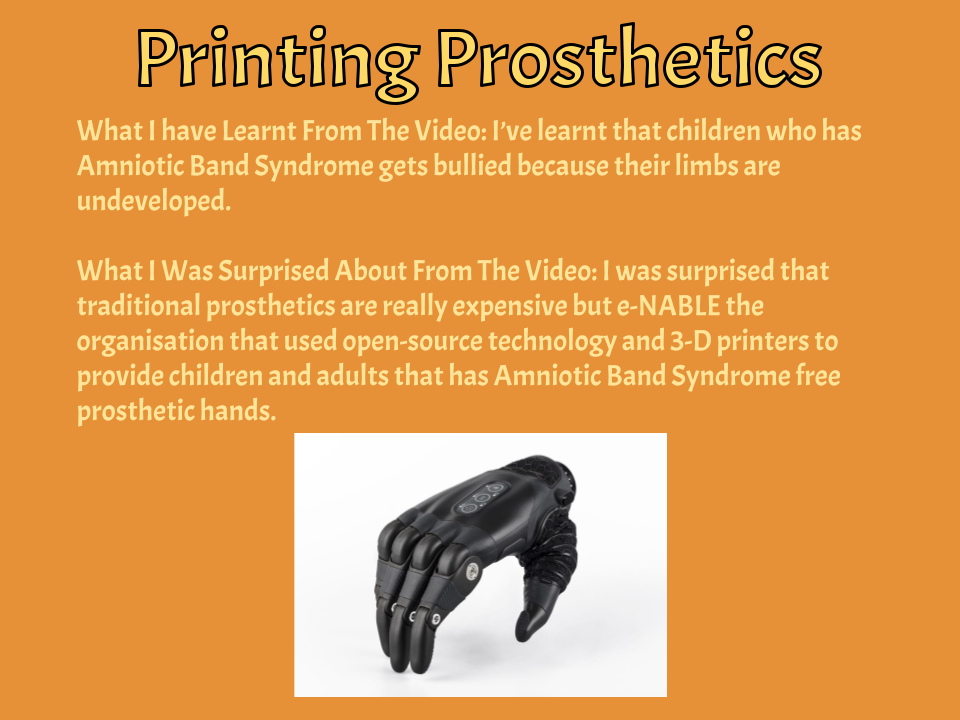 Image Attribution 2
Activity 2: Printing Prosthetics [4 points]
Image Attribution 2
Activity 2: Printing Prosthetics [4 points]
In 1983 a man named Chuck Hull invented the first 3D printer. A 3D printer follows a design that has been created on a computer. The printer simply ‘prints out’ the design in layers, often using a material like plastic.
3D printing has changed the way we are designing and manufacturing (creating) all sorts of things. It is possible to 3D print parts for machines, buildings and even humans!
If you have ever broken an arm and needed a plaster cast you will know that they’re not much fun to wear - especially in summer! Here in New Zealand, a man named Jake Evill has designed a lighter 3D printed plaster cast that is strong, recyclable, waterproof, and ventilated (let’s air in). Check out his design here.
For this activity, we would like you to learn more about 3D printed prosthetics (artificial body parts, like hands or arms). Please watch this video about 3D printed prosthetics (artificial body parts, like hands or arms).
On your blog, tell your readers:
One thing that you learned from watching this video
One thing that surprised you when watching this video
Activity 3: Need for Speed [6 points]
We have had many inventors here in New Zealand who have created things that have changed the world. Two of these inventors were Bill Hamilton (1899-1978) and John Britten (1950-1995).
Bill Hamilton grew up on a farm in the South Island of New Zealand. One of his first inventions was a tow rope to pull skiers up a ski field. His most famous invention, however, is the development of the modern jet boat engine. It allows boats, like the Huka Falls Jet, to travel at lightning speed along rivers. Bill Hamilton invented the jet boat to solve a problem.
John Britten, on the other hand, loved to rebuild vehicles, including motorbikes. He set up the Britten Motorcycle Company from his garage in Christchurch, New Zealand. One of his bikes, the V1000, won a number of international races and set a world speed record for going 304km per hour! Wow! Now that is fast…!
Image Attribution: Authors personal photo from Motorcycle Show in New Zealand, Jeremy Gray, CC BY-SA 3.0
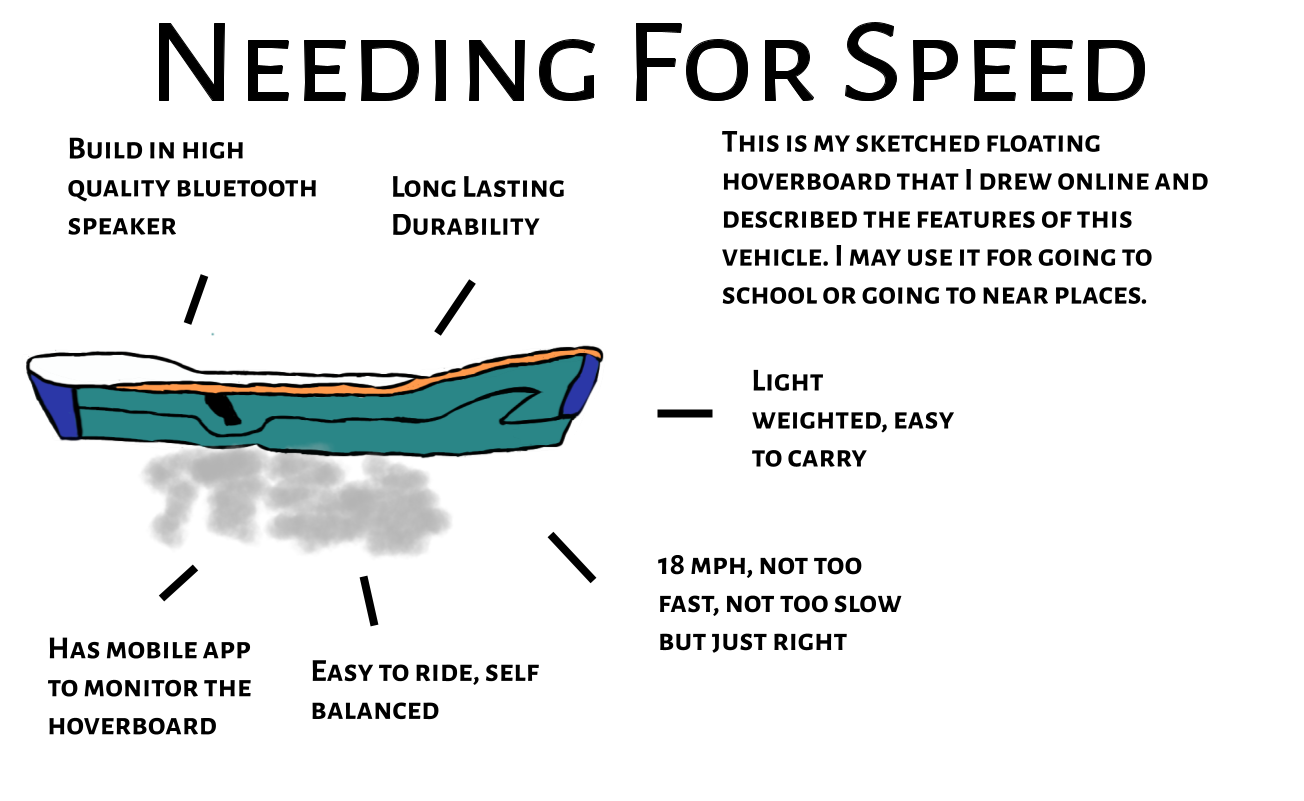
Speaking of fast, for this activity we would like you to design your own fast vehicle. It can be anything! Please draw your super-fast vehicle on paper or use an app to help you. If it was me, I would make my super-fast vehicle something that I could use to get to school and home again each day!
On your blog, post a picture of your speedy vehicle along with a written description of how it works. Tell your readers what your vehicle is made of, any special features, how fast it goes, and who might use your vehicle.
 Images Attribution 1
Images Attribution 2
Activity 1: Through Careful Observation [4 points]
Images Attribution 1
Images Attribution 2
Activity 1: Through Careful Observation [4 points]
There are many incredible people in history who have changed the world. Some have changed what we know about the world and about how it works. We often call these people ‘scientists’ or ‘theorists.’ Famous scientists include Sir Isaac Newton, Charles Darwin, Albert Einstein, Katherine Freese, Maria Goeppert Mayer and Sau Lan Wu.
Each of these scientists came up with a new theory (idea) about how things work. Much of what they discovered came from observing (watching) things closely.
For this activity, we would like you to select one of the pictures below and to study or observe it closely. What do you see?
On your blog, describe the painting in detail. What do you see when you look at it? Please give us as much detail as you can!

Activity 2: Overcoming Adversity [4 points]
Stephen Hawking (1942-2018) was an English scientist who was interested in studying the origin (beginning) of the universe. When he was just 21 years old, he was diagnosed with Motor Neuron Disease and, over time, he lost the ability to walk and talk. He needed to use a wheelchair to move around and a computer to help him to talk. The computer made his voice sound a bit funny but, most importantly, it meant he could still communicate with people.
Despite his diagnosis, Stephen Hawking lived a long and very productive life. He showed great determination and perseverance because he didn’t let his physical challenges stop him. He didn’t quit. Instead, he ‘overcame the odds’ and achieved a huge amount in his life.
Image Attribution: Stephen Hawking at NASA's StarChild Learning Center, NASA, Public Domain
For this activity, we would like to hear about a time when you, or someone you know, experienced a challenge and overcame it.
On your blog, recount a time when you or someone you know experienced a challenge and overcame it.

Activity 3: Hidden Figures [6 points]
Ada Lovelace, born in 1815, is considered to be the ‘first computer programmer’, even though computers had not yet been invented. She was called a computer programmer because she worked out a series of algorithms (instructions) that a machine could use to compute (calculate) difficult maths questions.
Katherine Johnson was another brilliant mathematician who worked with NASA - the North American Space Association. NASA was responsible for sending rockets and people into space. It was Katherine’s job to check all of the calculations that the engineers and astronauts used when designing the spacecraft and flying them into space. In 2016, a movie was made about Katherine Johnson and the other women who worked at NASA during this time. It is called ‘Hidden Figures.’ In the movie, the women had to learn how to do basic coding when NASA started using computers.
Have you ever tried coding?
For this activity we would like you to give coding a try. Click on the link for the website: code.org. If you try an activity and it is too easy, try a harder level!
On your blog, post a screenshot of your completed shape. Underneath the shape tell us what you thought of the coding app. Is it good? Why/why not?
 Link To Mathletics
Link To Xtramath
Link To Studyladder
Link To Moneytime
Activity 1: The World Wide Web [4 points]
Link To Mathletics
Link To Xtramath
Link To Studyladder
Link To Moneytime
Activity 1: The World Wide Web [4 points]
You may not have heard of Tim Berners-Lee but this man completely changed the world for us when he invented the World Wide Web (otherwise known as the ‘www’). All of the information on the internet is stored and accessed on the web.
TimBL, as he is known, also created the first ever website. We all spend a lot of time looking at websites, don’t we? One of my favourite websites is the Te Ara site. I use it when I am creating lessons for students or working on assignments for school. Are there websites that are particularly helpful for your learning?
For this activity please take screenshots of four different websites that you find helpful for your learning. They can be websites that you use in class or websites that you use on your own at home. Present the screenshots as a poster or put them into a presentation.
On your blog, share your poster or presentation of your favourite learning websites.
 Image Attribution 1
Image Attribution 2
Activity 2: Influencers [4 points]
Image Attribution 1
Image Attribution 2
Activity 2: Influencers [4 points]
YouTube is a video sharing website, where people can watch, create, share and comment on videos (a bit like when you Learn, Create and Share at school). YouTube was created in 2005 by three men - Chad Hurley, Steve Chen and Jawed Karim who later sold it to Google for $1.65 billion dollars!
Did you know that anyone can have their own YouTube channel? People who create videos and post them on YouTube are called ‘YouTubers’. Youtubers post videos on a huge range of topics from music to make-up, fitness to cooking, etc.
Most YouTubers create their own Youtube channel. People can subscribe to their channels and follow their videos. Do you watch or subscribe to any YouTube channels? If so, who are your favourite YouTubers? In New Zealand, there are many Youtubers, including Kiwi beauty YouTuber Miria Flavell and guitar guru, Nat Pua.
For this activity please imagine that you had the chance to create your own YouTube channel. What would it be about? What kinds of videos would you create and post?
On your blog, write a description of the YouTube channel you would like to create.
 Images Atribution 3
Images Attribution 4
Images Attribution 5
Images Attribution 6
Images Attribution 7
Images Attribution 8
Activity 3: Apple vs Microsoft [6 points]
Images Atribution 3
Images Attribution 4
Images Attribution 5
Images Attribution 6
Images Attribution 7
Images Attribution 8
Activity 3: Apple vs Microsoft [6 points]
Bill Gates and Steve Jobs are two big names in the field of digital technology. Bill Gates is the founder of Microsoft while Steve Jobs was a co-founder of Apple. Both men are very creative and inventive. In fact, Steve Jobs invented the Apple computer, iPod, iPhone, and iPad. Sadly, he passed away in 2011.
Bill Gates, on the other hand, invented Microsoft software, like Microsoft Windows and Microsoft Office. He is now one of the richest people in the world, and with his wife, Melinda, has created a charity called The Bill and Melinda Gates Foundation.
Both men worked in the same field (digital technology) and were seen as competitors or rivals. They are not the only rivals in the world. In fact, some of the most famous rivalries occur between sports teams. One example is the rivalry between the All Blacks and the Wallabies rugby teams.
Image Attribution: Steve Jobs and Bill Gates, Joi Ito, CC BY 2.0
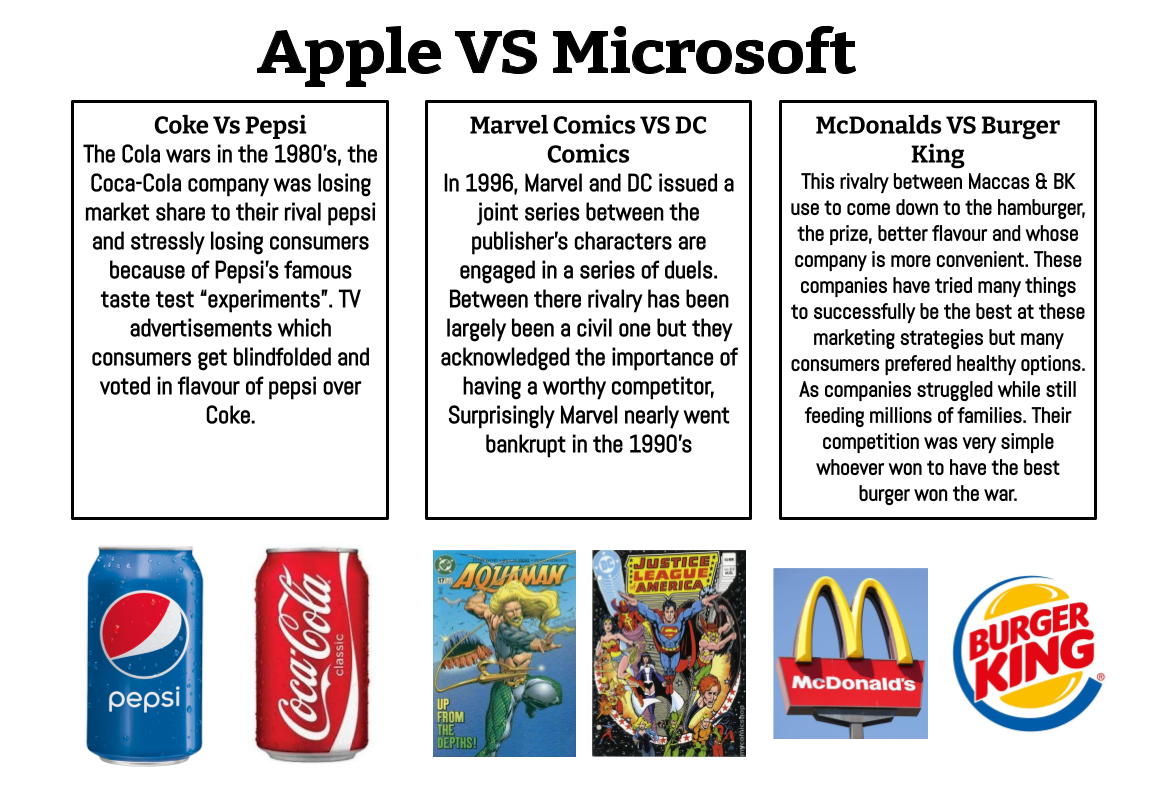
For this activity we would like you to use your best researching skills to find three more examples of common rivalries. They can be in the sports world or not - it’s totally up to you!
On your blog, describe the three rivalries that you have found. Who is involved? To gain the full 6 points for this activity, please provide a picture for each rivalry. The picture should represent the rivalry.
 Image Attribution 1
Image Attribution 2
Image Attribution 1
Image Attribution 2
Activity 1: Everyday Heroes [4 points]
Every day, the men and women in the Emergency Services provide help and support people in New Zealand and around the world. At times, they have to risk their lives in order to save others.
Common Emergency Services include the Fire Service, the Police Force and the Ambulance Service. Other related services include the Air Ambulance, Search and Rescue, Coast Guard, Surf Lifesaving, and the Civil Defence (amongst others).
In Australia, Fire Services are currently fighting more than 150 wildfires burning in New South Wales, a province on the east coast of the country. The wildfires started in November 2019 and are not expected to stop for many weeks. It is a very challenging time for the men and women serving in the Emergency Services in Australia.
Image Attribution: Emergency services to tackle Alps 2 Ocean for charity, Tim Lucas, stuff.co.nz
For this activity, please brainstorm at least five ways we could support the people who are affected by the fires in New South Wales, Australia. You could think of ways to raise money, things to send them, and ways to keep them feeling positive.
On your blog, share your brainstorm of ideas and create a video or audio recording of yourself explaining each idea.
Link To Audio

Activity 2: Leading by Example [4 points]
Mother Teresa and Princess Diana were both people who wanted to do things to help others. They were very different people, however they both had a significant impact on the world.
Mother Teresa was born in Eastern Europe but decided at a young age that she wanted to be a missionary (a person who gets sent somewhere to share their religious faith and do charity work). She moved to India where she worked hard and cared for those who needed her the most. Her work was recognised by the Catholic Church, which gave her the title of ‘Saint’ Teresa.
Diana, while not officially a saint, was a real-life princess. In her role as a princess, she travelled the world raising awareness about a number of important issues. Through her work, Princess Diana helped the world to see that all people, including those affected by illness and disease, needed love and respect. Princess Diana and Mother Teresa both led by example with acts of kindness towards others.
For this activity, we would like you to follow in their footsteps and perform a random act of kindness.
On your blog, describe your random act of kindness. What did you do? How did the person react? How did it make you feel?

Image Attribution 3
Image Attribution 4
Activity 3: Choose your own
You have now made it to the end of Week 2 and have earned the chance to choose your very own politician or activist who you think has changed the world. There are no right or wrong choices for this activity, so find someone who interests you and tell us about them on your blog. It could be someone from your family, church, community and/or someone famous who you admire.
Here are some starting points in case you get stuck:
Bill English
Xi Jinping
Pania Newton
Ellen Johnson Sirleaf
Willie Apiata
Jane Fonda
Image Attribution: Question Marks Cartoon #2002177
For this activity, choose one person and read all about them.
On your blog, provide us with:
The name of the person
A description of the work they do/have done
An explanation of how they/their work has had an impact on the lives of others
 Image Attribution 1
Image Attribution 2
Image Attribution 3
Activity 1: Guiding Principles [4 points]
Image Attribution 1
Image Attribution 2
Image Attribution 3
Activity 1: Guiding Principles [4 points]
Hōne Heke was a rangatira (chief) of Ngapuhi iwi in Northland. He was a strong and fearless warrior, and also an intelligent leader who fought for Māori rights during the British colonisation of Aotearoa, New Zealand. He was baptised a Christian in 1835 and had much respect for the missionaries that came to New Zealand. Hōne Heke supported Te Tiriti o Waitangi - the Treaty of Waitangi - and was the first rangatira to sign it in 1840.
However he soon realised that under Te Tiriti o Waitangi, Māori rangatira were losing their authority (power). In protest, he cut down the flagpole that flew the British flag at Kororareka (Russell) four times. He must have been very frustrated and angry.
Sometimes when we feel strongly (frustrated, angry, happy, excited, in awe…) we find it hard to put our feelings into words. Many cultures have sayings, proverbs or metaphors that can help people to explain their feelings or describe specific things. In Te Reo Māori, some people may use a whakataukī.
For this activity, read through the seven whakataukī (proverbs or metaphors) presented in this document. Choose one that has meaning for you. Create a poster that features the whakataukī and be sure to include at least one image (a drawing or photograph) on the poster that represents the whakataukī that you chose.
On your blog, share your poster of your whakataukī.
 Image Attribution 4
Image Attribution 5
Image Attribution 4
Image Attribution 5
Activity 2: Celebrating Diversity [4 points]
There are between 370 and 500 million Indigenous Peoples currently living in 90 countries around the world. Together, they represent over 5000 different cultures and speak 4000 different languages. That is pretty amazing ‘eh?! I wish that I could speak 4000 languages!
Indigenous People is the term used to describe the people who were the first inhabitants of a land. In Aotearoa, Māori are Indigenous. Indigenous people have rich and vibrant cultures that make the world such a fascinating, varied and enriching place to live.
Image Attribution: 2019 NAIDOC Poster by Charmaine Mumbulla is licensed under CC BY-NC-N4 4.0
For this activity we are going to become more familiar with some of these amazing indigenous communities. Please click on the links below to learn more about these fascinating groups.
Ainu People
Australian Aboriginal People
The Inuit People
Papuan People
The Maya People
Once you have finished learning about these groups, please choose the two that interest you the most.
On your blog tell us the names of the two groups that you chose and then tell us at least two interesting facts about each group. To earn full points, you must provide two facts about both groups - 4 facts in total.
 Activity 3: Wise Words [4 points]
Sir Āpirana Ngata and Dame Whina Cooper were both influential leaders who fought for Māori rights. Āpirana Ngata was a lawyer and politician. He worked hard to give rights to Māori land owners, and he also spent a lot of his career encouraging Māori to preserve the culture - haka, poi, whakairo (carving), waiata (song), sport and the construction of more marae around Aotearoa, New Zealand.
Whina Cooper was the first president of the Māori Women’s Welfare League, which worked on improving health, education, housing and welfare for Māori women in New Zealand in the 1950s. She led the Māori land hikoi (march) from Northland to Wellington to protest against the loss of Māori land. She was nearly 80 years old at the time. Both of these individuals are examples of wise, inspiring leaders and role models.
For this activity, please identify someone in your life who is a role model to you. This could be a parent, grandparent, neighbour, minister, imam, rabbi etc. Please ask them to share one piece of wisdom (advice) with you that they think you and your blog readers should hear.
On your blog, share this wisdom with your readers.
 Image Attribution 1
Image Attribution 2
Image Attribution 1
Image Attribution 2
Activity 1: The Right to Vote [4 points]
Kate Sheppard was a very famous and important New Zealander. In the late 1800s, she fought for women to have the right to vote in elections. She did this by creating petitions (lists with the names of people who supported her), running public meetings, writing letters to the newspaper, and talking to politicians.
As a result of her hard work, women in New Zealand (NZ) were first granted the right to vote in 1893. This made NZ the first country in the world to give women the right to vote. We call this right ‘women’s suffrage’.
In honour of Kate Sheppard’s work, the NZ government has put her image on the current $10 note.
Image Attribution: Kate Sheppard, William Sidney Smith, Public Domain
For this activity, let’s imagine that the government decides to create a new $10 bank note and replace Kate with a picture of a different New Zealand woman.
On your blog, tell us who you think the government should put on the new $10 note. Please provide us with a picture of this amazing woman and a short explanation of why you have selected her as Kate Sheppard’s replacement.
*Remember to attribute any images that you borrow from the internet or from other people.
*Please check out the Eye-Catching Blog Posts page for ideas!
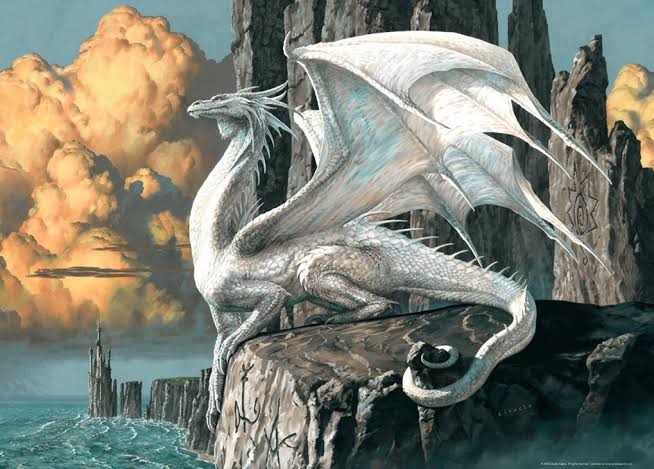
Once upon a time inside a mountain forest, there was once a little girl named Hailey, long wavy hair covered with a royal blue hood that’s almost fading its colour, she is a really timid girl who's almost scared of everything. She wore a torn out cape under it is a silky white dress that has several dirt stains on it. She was walking around the forest, looking really afraid of how the forest looked really dull and frightening, she’s intimidated by it. She noticed a path leading to a mysterious place, she was unsure of herself as she asks herself in her mind, “should I follow this path or not?”. As she decides to step on the path, foot by foot and continuously walk along the path. During her little stroll on the path and spotted an enormous cave that was as daunting as ever. She immediately felt really scared, thinking about running away but Hailey felt really attentive and wanted to investigate what’s inside the cave. She stepped into the cave slowly as she recognizes a great gigantic beast, a snow dragon. Its scaly skin glimmers as a sparkling diamond, it was sleeping calmly, looking as gentle. It slowly awoken from its slumber and roared as loudly as a lion, Hailey was petrified she almost wanted to burst into tears but she felt a strange feeling as it makes her feel less frightened. She calmly relaxed for a bit, inhaling and exhaling really loudly, she slowly laid her hand on the dragon’s skin, stroking its skin gentilly at a time. As Hailey petted the dragon endlessly ended being night time already, she felt a little drowsy. The snow dragon deliberately went back to its sleep following Hailey slowly slept on the dragon. The next morning Hailey woke up, feeling a good mood, as she noticed the dragon wasn’t here and seeing her back in the mountain forest. Her good mood turned into the opposite of it. She asked herself, “Where did the dragon went?” “Was it only a dream?”. As she strolled around the forest, nowhere to go, she spotted a tiny piece of skin on the ground, She reminds her of the dragon, glittery and scaly, sparkling like diamonds. She kept on looking everywhere but the snow dragon was unable to be found.
Image Attribution 3
Activity 2: The Right to an Education [4 points]
Malala Yousafzai is a woman who was born and raised in Pakistan. In 2012, she was shot and wounded when traveling home on the bus from school. At the time, girls (and women) living in Pakistan were not encouraged, or even allowed, to go to school. It is widely believed that Malala was attacked because she (and her father) did not agree with this idea and they felt that women had the right to an education.
Once Malala recovered from her injuries she continued to advocate (fight) for the rights of all women to receive an education. For this work, she was awarded the Nobel Peace Prize in 2014 - the youngest person to ever receive this prestigious prize. You can read more of her story here.
As well as giving speeches in front of many very important and influential people, Malala has written books about her own life. She has also written a book for children called Malala’s Magic Pencil.
For this activity, we would like you like you to write a short story. The story can be about anything that you wish but to receive full points it must be at least 10 sentences long!
On your blog, share your short story. We can’t wait to read it
 Image Attribution 4
Activity 3: Belle of the Ball [6 points]
Image Attribution 4
Activity 3: Belle of the Ball [6 points]
Emma Watson is a movie star who started acting in films when she was just nine years old. You might recognise her as Hermione Granger from the Harry Potter films or ‘Belle’ from the Disney adaptation of Beauty and the Beast.
When Emma is not acting, she spends a lot of time giving speeches and advocating for the rights of women and girls. In 2014 she launched the HeForShe campaign which encourages men and boys to actively support women and girls by speaking out about gender equality - the idea that males (men) and females (women) have the same rights. Emma is also an avid reader who started her own worldwide book club!
Let’s imagine that Emma has just emailed you and asked for your help. She needs a recommendation for a great book for her book club. She also needs you to prepare a short review of the book to share with her readers.
For this activity, choose a book that you like and write a short review of it. In the review, tell us what the book is about and what you like about it.
On your blog, share your book review with a photo or illustration (drawing) of the book.
